The Merlin-662CRS is a 2MP IMX662 USB Camera built around the Sony STARVIS 2 IMX662 sensor, validated for ultra-low-light imaging in challenging lighting conditions. Its enhanced low-light sensitivity and HDR capability enable the camera to capture usable image detail in dim environments and high-contrast scenes, while USB connectivity and UVC compatibility simplify integration with embedded systems, industrial PCs, and other host platforms. Designed for OEMs and system integrators, this Low Light USB Camera provides a Sony STARVIS USB Camera platform for applications that require reliable imaging when available light is limited.
FORT WORTH, TX / ACCESS Newswire / October 5, 2026 / Vadzo Imaging, a provider of embedded vision solutions, today validated the Merlin-662CRS, an IMX662 USB Camera built around the Sony STARVIS 2 IMX662 sensor for applications that require reliable imaging in challenging and low-light conditions. Combining the sensor’s enhanced low-light sensitivity with HDR imaging and USB UVC connectivity, the Merlin-662CRS provides a Low Light USB Camera platform for video conferencing, webinars, content creation, and other embedded vision applications where consistent image quality is required across real-world lighting conditions.
Why Video Conferencing Needs an IMX662 HDR USB Camera Built for Real Room Lighting
A standard webcam sensor is often tuned for a brightly and evenly lit studio environment, which does not reflect the actual lighting most people have available in a home office, a shared workspace, or a conference room with mixed overhead and window lighting. A USB Streaming Camera needs to handle that genuine variety of lighting conditions rather than assuming an ideal, evenly lit setup that few real callers actually have.
Low-latency USB Streaming addresses a related but separate concern, since a delay between a participant’s actual movement and its appearance on screen disrupts the natural flow of a live conversation regardless of how good the underlying image quality otherwise looks. A Sony Starvis IMX662 USB Camera needs to minimize that delay specifically, which matters directly for the real-time back-and-forth a video call or a live webinar depends on.
A third consideration is whether image quality holds up specifically in the two lighting scenarios that come up most often on a real video call: a dimly lit room and a backlit window behind the person speaking. A Sony IMX662 USB Camera that performs well only in bright, even lighting leaves exactly these common scenarios underserved, which is where most of the visible quality complaints in everyday video conferencing actually originate.
Neither low light sensitivity nor HDR alone solves the full range of lighting problems a real video call presents. A camera with excellent low light sensitivity but no HDR still struggles the moment a bright window enters the frame, and a camera with excellent HDR but weak low light sensitivity still produces a dark, noisy image the moment a room’s overall lighting drops. Combining both is what makes a camera genuinely suited to the actual, varied lighting conditions people call and stream from, rather than adequate in only one specific scenario.
Engineering Explanation: Low Light Sensitivity and HDR Working Together for Streaming
Sony built the IMX662 as part of its STARVIS 2 sensor family, and Vadzo Imaging validates that sensor specifically for the genuine combination of low light sensitivity and HDR handling that real video conferencing and content creation environments actually require. As a Continuous USB Streaming Camera, the Merlin-662CRS maintains stable, uninterrupted video across long calls and recording sessions, rather than a connection validated only for a brief demonstration.
That stability holds up alongside genuinely low-latency streaming, since a camera that stays connected but introduces meaningful delay still disrupts the natural back-and-forth of a live conversation. As a Real-Time USB Streaming device, the Merlin-662CRS minimizes that delay specifically, functioning as a genuine USB Video Capture Module and giving video conferencing and webinar platforms the responsiveness a live interaction depends on.
Genuine low light sensitivity extends that quality into the dim rooms many people call from, particularly during early morning or evening hours when natural light is limited. As a Low-Light USB Streaming Sensor, the Merlin-662CRS resolves a clear, usable image in exactly these conditions, rather than the dark, grainy video a less sensitive webcam sensor produces under the same dim lighting.
A 2MP USB Streaming Sensor delivers that low light sensitivity alongside genuine HDR handling for the backlit window scenario, holding detail in both a bright window and a person’s face simultaneously rather than forcing a trade-off between the two that leaves one of them poorly exposed.
Product Overview
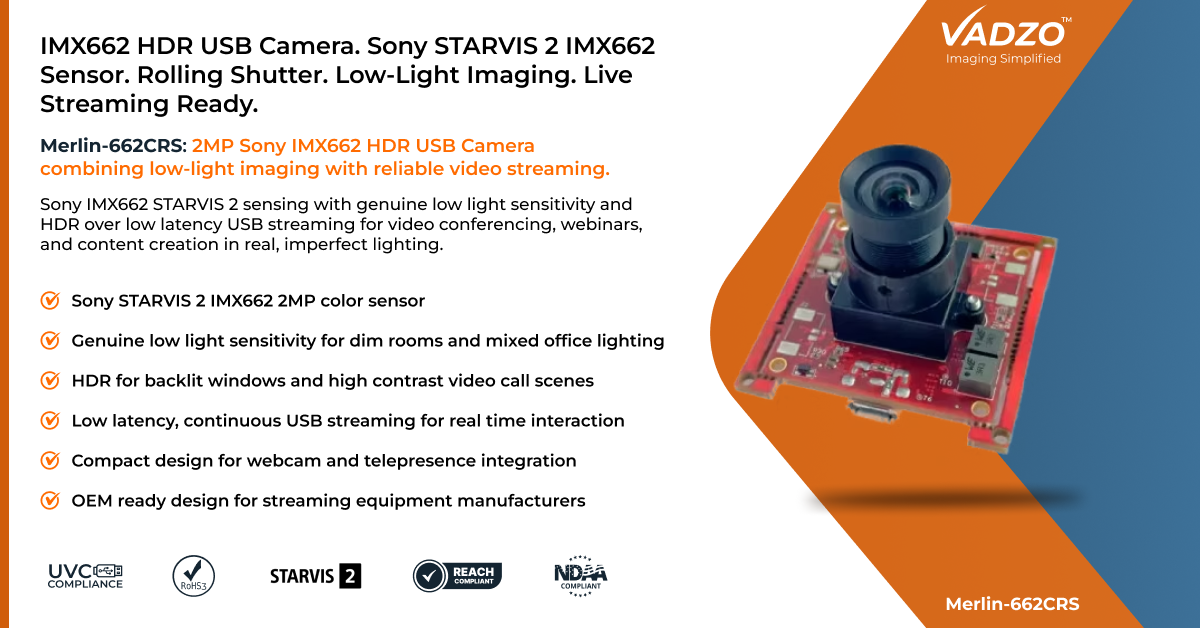
The Merlin-662CRS pairs the 2MP HDR USB Camera sensor’s genuine low-light sensitivity with HDR handling in a compact design suited to video conferencing, webinar, and content creation integration. As an IMX662 2MP HDR USB Camera, it outputs full 1080p resolution with both low-light and HDR processing active by default, giving hosts and participants professional video quality across a room’s brightest and dimmest moments from the same hardware.
At the core of the module sits the IMX662 USB Video Streaming Camera, selected specifically for the combination of low light sensitivity, HDR handling, and streaming reliability that continuous video applications require. Because the camera pairs that image quality with genuine streaming stability, the Merlin-662CRS reaches usable professional quality as a 2MP Video Capture USB Camera across a full range of real-world lighting scenarios, delivered as a 1080p Low-Light Streaming Camera suited to demanding continuous use.
Product Specifications
Key specs: 2MP (1920 × 1080) Max Resolution | Sony STARVIS 2 IMX662, 1/2.8-inch Sensor Format | 2.9 µm Pixel | Color, Rolling Shutter with HDR | USB 2.0 UVC Interface | S-Mount (M12) Optics
Key Capabilities
Sony IMX662 STARVIS 2 Sensor for Detailed 2MP HDR Streaming: The Merlin-662CRS is built around the Sony IMX662 sensor, resolving fine detail across both dim and high-contrast lighting conditions from the same hardware. This gives the module dependable performance suited to video conferencing and content creation tasks where a poorly exposed frame directly undermines the professional impression a call or a recording is meant to convey. That consistency matters directly for repeated use across many calls and recording sessions, where a viewer or participant should notice the conversation itself rather than any variation in image quality from one session to the next.
Low-Light Sensitivity for Professional Quality in Dim Rooms: A dimly lit home office, a shared workspace with limited overhead lighting, or a call taken during early morning or evening hours all present the same underlying challenge: a room without enough visible light for a standard webcam sensor to produce a clear image. The Merlin-662CRS’s genuine STARVIS 2 low-light sensitivity resolves usable detail in exactly these conditions, avoiding the dark, grainy video a less capable sensor would produce under the same dim lighting. That genuine sensitivity matters most for the calls and recordings that cannot simply be rescheduled for better lighting, since a real meeting or a live webinar happens on its own schedule regardless of what natural light happens to be available at that specific time.
HDR for Backlit Windows and Mixed Office Lighting: A person seated in front of a bright window is one of the most common lighting complaints in video conferencing, since a camera without HDR typically forces a choice between an underexposed, silhouetted face or a completely washed-out window. The Merlin-662CRS’s HDR handling holds detail in both the window and the person’s face simultaneously, resolving a scenario that a standard webcam sensor consistently struggles with. That capability matters most in exactly the settings a video conferencing camera cannot control in advance, since a participant’s desk position relative to a window is rarely something a camera manufacturer can assume or adjust for ahead of time.
Low Latency, Continuous USB Streaming for Real-Time Interaction: As a 1080p USB Streaming Camera, the Merlin-662CRS enumerates automatically on Windows, Linux, and Android without a proprietary driver install, which matters directly for video conferencing and webinar platforms that already expect a standard UVC device. As a genuine Live USB Streaming Camera, it delivers the low latency and continuous connection a real-time conversation depends on, and as a Plug and Play USB Streaming device, it requires no specialized capture card or interface to get started.
Compact Design for Webcam and Telepresence Integration: Webcam housings, telepresence units, and content creation rigs often have genuinely limited internal space, leaving little room for a camera and its supporting electronics. The Merlin-662CRS’s compact design fits into that constrained space, integrating directly into existing streaming hardware without requiring a custom enclosure redesign. That compatibility matters directly for manufacturers upgrading an established webcam or telepresence product line to better low-light and HDR performance, since redesigning housing across an entire product family would add real cost and time to what should otherwise be a straightforward sensor upgrade.
OEM Ready Design for Streaming Equipment Manufacturers: Streaming equipment manufacturers producing units at scale need a camera platform that stays consistent across a long production run, from early prototype validation through full-scale manufacturing. Vadzo Imaging supports full customization on this platform as an OEM USB Streaming Module, including connector changes, housing design, and firmware adjustments for manufacturers headed into volume production, and as a Remote USB Streaming Module, it gives OEM customers a proven foundation to build a differentiated conferencing or broadcast product around. As a UVC Streaming Camera Kit, it fits directly into a manufacturer’s existing platform architecture.
“Video conferencing and content creation teams keep telling us the same thing: a camera that looks great in a bright, evenly lit demo often looks noticeably worse the moment someone calls from a dim room or sits in front of a window. The IMX662’s genuine low light sensitivity combined with HDR gives the Merlin-662CRS real image quality in exactly those common, imperfect conditions, not just a favorable studio demonstration. We built this camera for the rooms people call from, not an idealized broadcast set.” – Alwin Vincent, Product Manager at Vadzo Imaging.
Application-Specific Sections
Video Conferencing in Realistic Office and Home Lighting: Video conferencing happens in genuinely varied lighting, from a well lit office to a dim home study to a room with a bright window directly behind a participant. As a USB Video Conferencing Camera, the Merlin-662CRS supports that full lighting range, giving remote teams consistent professional quality regardless of where a specific call happens. That consistency matters directly for distributed teams spanning many individual home offices, where a company cannot control each participant’s actual lighting setup but can still standardize on camera hardware capable of handling that variation gracefully.
Webinar and Content Creation Streaming: Webinar hosts and content creators depend on consistent, professional quality across every session, since inconsistent lighting handling between one recording and the next undermines a channel or a brand’s polished appearance. As a Webinar USB Streaming Camera, the Merlin-662CRS supports that consistency, and functioning as a USB Content Streaming Camera, it extends the same reliable quality to broader content creation and recording workflows.
Telepresence and Remote Collaboration Systems: Telepresence systems and remote collaboration platforms depend on a natural, low-latency video experience that lets participants forget about the underlying technology and focus on the conversation itself. As a Telepresence USB Camera Module, the Merlin-662CRS supports that natural interaction, giving dedicated collaboration hardware the same image quality and responsiveness a standard video call depends on.
Interactive Kiosk and Broadcast Streaming: Interactive kiosks and small-scale broadcast setups often operate in spaces with lighting the original installer did not fully control, from a bright entryway window to a dim corner display position. As a USB Streaming Kiosk Camera, the Merlin-662CRS supports that lighting variability, functioning as a USB Broadcast Camera Module for broader small-scale broadcast applications, and as an Interactive USB Streaming Camera, it gives kiosk designers dependable video quality regardless of a specific installation’s lighting quirks. That dependability matters directly for installations deployed across many physical locations, where a single camera platform validated for varied lighting avoids the need to custom tune each individual site.
OEM Integration for Streaming Equipment Manufacturers: Streaming equipment manufacturers building their own conferencing, webinar, or broadcast hardware need a camera vendor who understands the low light, HDR, and latency requirements those systems demand together. The Merlin-662CRS ships from a USB Streaming Camera Supplier with those requirements built in, and Vadzo Imaging supports OEM customization for cable length, connector type, and firmware for manufacturers standardizing on one camera across multiple streaming product lines. As a USB Streaming Camera Kit, it fits directly into a manufacturer’s existing platform architecture.
Frequently Asked Questions
Q: Why does video conferencing specifically benefit from a camera with both low light sensitivity and HDR, rather than just a standard webcam sensor?
A: A standard webcam sensor is often tuned for a brightly and evenly lit studio environment, which does not reflect the actual lighting most people have available in a home office, a shared workspace, or a conference room with mixed overhead and window lighting. Low light sensitivity addresses the frequent problem of a dimly lit room producing a dark, grainy video image, while HDR addresses a separate but equally common problem: a bright window or overhead light source creating a silhouette effect that hides a person’s face in shadow. The Merlin-662CRS combines both capabilities specifically because a genuinely reliable video conferencing camera needs to handle the actual range of lighting conditions people call from, not just a single, ideal studio setup.
Q: How does HDR help specifically when a person on a video call is sitting in front of a bright window?
A: A camera without HDR typically exposes a frame for either the bright window or the person’s face, but not both accurately at the same time, which means a bright window in the background often forces the camera to underexpose the person’s face into a dark silhouette, or properly expose the face while the window washes out into a featureless bright rectangle. HDR captures multiple exposure levels and combines them into a single frame, holding detail in both the bright window and the person’s face simultaneously rather than forcing that same trade-off. The Merlin-662CRS’s HDR handling is built specifically to solve this common video call scenario, since a backlit window is one of the most frequent lighting complaints in home office and shared workspace video conferencing setups.
Q: Can this camera deliver professional quality video for both video conferencing and pre-recorded content creation, or is it optimized for only one use case?
A: Video conferencing and pre-recorded content creation share more underlying technical requirements than they differ on, since both depend on accurate color, genuine low-light sensitivity, and reliable HDR handling to look professional regardless of whether the video is being watched live or reviewed later during editing. The Merlin-662CRS is built around those shared requirements rather than a single narrow use case, giving a webinar host, a content creator, and a video conferencing user the same underlying image quality from one camera. Content creators specifically benefit from the same low-light and HDR handling that helps a video call participant, since a recording studio, a home streaming setup, and a conference room all present the same fundamental lighting challenges a single well-engineered sensor can address.
Q: Can Vadzo Imaging customize a low-light HDR USB streaming camera module for a specific conferencing or broadcast platform?
A: Yes. Vadzo Imaging supports full OEM customization on the Merlin-662CRS, including optics selection suited to a specific field of view or mounting position, connector and cable configuration matched to a particular device housing, and firmware adjustments tuned for a specific balance of low light sensitivity and HDR handling. Evaluation units ship with no minimum order requirement, and the same engineering team that built the standard product works directly with equipment manufacturers to adapt the module for a specific video conferencing, webinar, or broadcast platform headed into volume production.
Q: What should equipment manufacturers look for when choosing a low light HDR USB streaming camera supplier?
A: A camera that looks acceptable in a single, well-lit demonstration setup does not necessarily deliver the same quality once tested against the genuinely varied lighting conditions real users actually call or stream from, including dim rooms and backlit windows. Manufacturers should look for genuine low-light sensitivity and HDR performance validated across realistic, imperfect lighting scenarios rather than one favorable demonstration, low-latency streaming suited to real-time interaction, and a supplier able to support customization for a specific conferencing or broadcast platform. The Merlin-662CRS is built around exactly these priorities, since a genuinely professional streaming camera depends on consistent quality across the real lighting conditions users actually encounter, not just a single ideal test setup.
Availability
The Merlin-662CRS IMX662 HDR USB Camera is available now and ready for evaluation and OEM integration. Evaluation kits include the camera module, a factory-calibrated lens, a USB cable, and integration documentation covering low light and HDR configuration, with no minimum order requirement. Contact Vadzo Imaging at support@vadzoimaging.com to request an evaluation unit or discuss volume production and OEM customization. Evaluation feedback is also welcome directly through the same contact channel, since real conferencing and streaming conditions often surface details a brief bench test alone would not reveal, and that feedback helps confirm a configuration before a manufacturer commits to a full production order across an entire product line.
About Vadzo Imaging
Vadzo Imaging develops embedded and machine vision camera products for OEMs, system integrators, and streaming equipment manufacturers building production-ready vision systems across video conferencing, content creation, broadcast, and edge AI applications. The company’s portfolio spans MIPI CSI-2, USB, GigE, Wi-Fi, FPD-Link III, and SerDes interface camera products, supporting deployment architectures from compact onboard modules to distributed networked installations. Vadzo provides end-to-end imaging support, including sensor integration, ISP tuning, firmware development, and SDK frameworks to accelerate system deployment, and the company’s engineering team works directly with customers throughout evaluation, pilot deployment, and volume production rather than handing off support after the initial sale. That ongoing engineering relationship matters most for streaming programs, where a camera platform may remain part of a widely deployed conferencing or content platform for years after initial release. Visit Vadzo Imaging to explore the full embedded vision camera portfolio.
Media Contact
Alwin Vincent
Vadzo Imaging
Email: alwin@vadzoimaging.com
LinkedIn: Vadzo Imaging
YouTube: Vadzo Imaging
X: Vadzo Imaging
SOURCE: Vadzo Imaging
View the original press release on ACCESS Newswire
Media gallery