Glass fiber composites hold 62% of the Wind Turbine Rotor Blade Market by value, reflecting their cost-effectiveness for onshore applications under 80 meters.
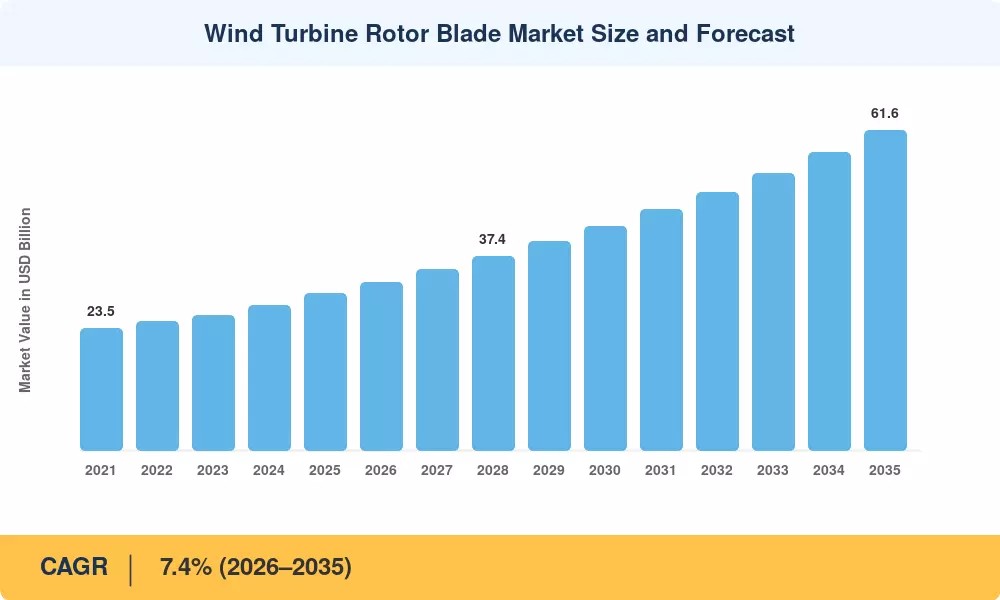
NEW YORK, NY, UNITED STATES, July 24, 2026 /EINPresswire.com/ — The global Wind Turbine Rotor Blade Market reached an estimated USD 30.2 billion in 2025 and is projected to grow from USD 32.4 billion in 2026 to USD 61.6 billion by 2035, registering a CAGR of 7.4% during the forecast period (2026–2035).
Market Overview
Wind turbine rotor blades are the critical aerodynamic components responsible for capturing kinetic energy from wind and converting it into rotational mechanical energy. These blades, manufactured from advanced composite materials such as fiberglass-reinforced polyester, epoxy, carbon fiber, and balsa wood core materials, are engineered to optimize aerodynamic efficiency, structural integrity, and fatigue resistance. Modern rotor blades range from 40 meters to over 120 meters in length, with offshore turbines featuring the largest blades ever manufactured. The rotor blade segment accounts for approximately 25-30% of the total wind turbine cost, making it the most technologically intensive component in wind energy systems.
Growth Drivers
The market’s robust expansion is fundamentally driven by the global energy transition toward renewable sources and ambitious net-zero emissions targets. Governments worldwide are aggressively expanding wind power capacity, with the Global Wind Energy Council reporting cumulative installed capacity surpassing 1,000 GW in 2025. The increasing size and power rating of wind turbines—now reaching 15-20 MW for offshore installations—directly correlates with larger blade requirements. Furthermore, falling levelized cost of energy for wind power, now competitive with fossil fuels in most markets, has accelerated project development and repowering activities. The offshore wind sector is experiencing unprecedented growth, with major projects in the North Sea, East China Sea, and U.S. Atlantic coast requiring specialized, corrosion-resistant blades designed for harsh marine environments.
Industry Trends & Technological Developments
The industry is witnessing a paradigm shift toward ultra-long blades exceeding 100 meters, enabled by advances in carbon fiber composites and additive manufacturing technologies. Carbon fiber adoption is increasing significantly, offering superior strength-to-weight ratios and enabling longer blades with reduced mass. The development of segmented or modular blade designs is gaining traction, addressing transportation and logistics challenges associated with oversized blades. Digital twin technology is being integrated into blade manufacturing and maintenance, allowing real-time performance monitoring and predictive maintenance. Additionally, manufacturers are exploring thermoplastic composites that offer improved recyclability, addressing growing environmental concerns about blade disposal. The use of artificial intelligence in aerodynamic optimization and manufacturing process control is becoming standard practice among leading manufacturers.
Policy & Regulatory Influence
Regulatory frameworks have been instrumental in shaping the market. The European Union’s Renewable Energy Directive (RED III), U.S. Inflation Reduction Act, and China’s 14th Five-Year Plan for Renewable Energy include ambitious wind capacity targets that directly stimulate blade demand. The expansion of offshore wind leasing rounds in the U.S., UK, and Asian markets has created a multi-year pipeline of projects. Additionally, the EU’s proposed ban on landfilling wind turbine blades by 2025 is accelerating investment in blade recycling technologies. Local content requirements in several countries are encouraging domestic blade manufacturing capacity, reshaping global supply chains.
Demand Outlook
The demand outlook remains exceptionally strong, with wind capacity additions projected to exceed 150 GW annually by 2030. Replacement demand is also emerging as a significant factor, with the first generation of wind farms requiring repowering, often with larger, more efficient blades. The offshore segment is expected to grow at an even faster rate than onshore, creating demand for blades exceeding 100 meters.
Get Free Sample Report for Detailed Market Insights:
https://www.marketresearchfuture.com/sample_request/29445
Market Segmentation
The Wind Turbine Rotor Blade Market is comprehensively segmented to capture the diverse dynamics across different blade types, manufacturing processes, and end-use applications.
By Blade Material
Fiberglass (GFRP) Composites: The dominant segment, widely used for onshore applications, offering an optimal balance of cost, strength, and fatigue resistance. Carbon Fiber Composites: The fastest-growing segment, increasingly adopted for offshore and ultra-large blades where weight reduction is critical. Hybrid Composites: Combining fiberglass and carbon fiber to achieve cost-performance optimization. Balsa Wood & Core Materials: Used as structural core materials in sandwich construction for weight reduction.
By Blade Length
80 Meters: The high-growth segment, driven by offshore and large-scale onshore projects (6+ MW).
By Manufacturing Process
Hand Lay-up: Traditional process used for smaller blades and prototype development. Resin Infusion: The dominant process for large-scale production, offering superior consistency. Pre-preg & Automated Fiber Placement: High-performance processes gaining traction for offshore applications.
By Application
Onshore Wind Farms: Largest market segment, driven by repowering and new project development. Offshore Wind Farms: High-growth segment requiring specialized blades with enhanced corrosion protection.
You can buy this market report at:
https://www.marketresearchfuture.com/checkout?currency=one_user-USD&report_id=29445
Regional Analysis
North America
North America is a significant and rapidly growing market, driven by the U.S. Inflation Reduction Act’s extension of production tax credits and investment tax credits for wind energy. The U.S. offshore wind sector is finally gaining momentum, with projects such as Vineyard Wind and South Fork Wind representing a new frontier for large blades. Blade manufacturers are establishing new facilities in coastal locations to serve this emerging offshore market. Canada’s wind capacity is also expanding, particularly in Ontario and Quebec. The region is characterized by strong technological innovation and emphasis on supply chain localization.
Europe
Europe remains the global leader in offshore wind technology and deployment, accounting for over 40% of the global offshore market. The North Sea continues to host the world’s largest offshore wind projects, with blades exceeding 100 meters now common for 15+ MW turbines. European manufacturers such as LM Wind Power (GE), Vestas, and Siemens Gamesa maintain advanced R&D facilities, driving innovation in carbon fiber composites and manufacturing processes. The region is also at the forefront of developing blade recycling technologies, with the industry committed to achieving 100% circularity by 2035.
Asia-Pacific
Asia-Pacific is the largest and fastest-growing regional market, led by China’s dominant position in global wind energy. China installed over 50 GW of new wind capacity in 2025 and is aggressively expanding offshore wind in the South China Sea and East China Sea. Chinese blade manufacturers, including Sany Heavy Industry and Mingyang Smart Energy, are rapidly scaling up production capacity. India’s wind market is also expanding significantly, with the government targeting 140 GW of wind capacity by 2030. The region benefits from lower manufacturing costs, extensive supply chains, and strong policy support.
Rest of the World
Latin America and the Middle East & Africa represent emerging markets with substantial growth potential. Brazil and Mexico lead Latin American wind adoption, with major projects in the Northeast and Baja regions. The Middle East is beginning to explore wind potential in regions such as Oman and Jordan, while South Africa’s REIPPP program continues to drive wind development.
Competitive Landscape / Key Players
The Wind Turbine Rotor Blade Market is characterized by a mix of vertically integrated wind turbine manufacturers, specialized blade companies, and regional players. The market has seen significant consolidation and strategic partnerships to secure supply chains and local content compliance.
Key Companies
LM Wind Power (GE Renewable Energy): The world’s largest blade manufacturer, pioneering blades exceeding 100 meters for offshore applications.
Siemens Gamesa Renewable Energy: Integrated turbine manufacturer with in-house blade production across multiple global locations.
Vestas: A leading global wind turbine manufacturer, known for innovative blade designs and advanced composite manufacturing.
Sany Heavy Industry: Dominant Chinese blade manufacturer, rapidly expanding its product portfolio and global footprint.
TPI Composites: A leading independent blade manufacturer, supplying multiple OEMs from manufacturing facilities across the U.S., Mexico, and Asia.
Strategic Developments
Recent strategic movements include major blade manufacturers establishing new production facilities at portside locations to serve offshore projects, partnering with shipping companies to develop specialized transport vessels for ultra-long blades, and investing heavily in R&D for recyclable blades. In 2025, GE Vernova announced a partnership with a leading carbon fiber manufacturer to secure supply chains for its next-generation 20 MW offshore turbine platform.
Latest Industry News & Developments
TPI Composites Reports Increased Repowering Business: The company’s Q1 2026 outlook shows a 25% year-over-year increase in repowering orders, driven by operational data from condition monitoring systems. This trend is creating a robust market for blade replacements in legacy wind farms.
EU Proposes Ban on Landfilling Wind Turbine Blades: The European Union is advancing a proposed ban on landfilling wind turbine blades by 2025, accelerating industry investment in blade recycling technologies and circular economy initiatives.
Carbon Fiber Advancements: Ongoing lab-scale tests in 2025 of carbon fiber reinforced polymers have yielded a 15% increase in specific fatigue resistance, potentially extending blade lifetimes to 35 years. This development is expected to accelerate carbon fiber adoption in the 100+ meter blade segment.
Market Challenges & Opportunities
Key Restraints
Logistical Challenges: Transporting and handling ultra-long blades exceeding 80 meters presents significant logistical difficulties, requiring specialized vehicles and proximity to ports. Infrastructure constraints remain a key barrier in emerging markets.
Raw Material Price Volatility: The industry is exposed to fluctuations in raw material costs, particularly carbon fiber, epoxy resins, and balsa wood. Supply chain disruptions can significantly impact manufacturing costs.
End-of-Life Disposal: As the first generation of blades reaches end-of-life, landfill disposal has become an environmental concern. While recycling technologies are emerging, cost-effective, large-scale solutions remain under development.
Technical Limitations: Carbon fiber’s higher cost and limited availability constrain widespread adoption. Manufacturing defects in large blades can lead to catastrophic failures.
Emerging Opportunities
Blade Recycling & Circular Economy: The development of cost-effective, scalable blade recycling technologies represents a major opportunity. Thermoplastic composites that can be reprocessed, as well as chemical recycling methods for thermosets, offer significant potential.
Smart Blades & Digital Monitoring: Integration of sensors, IoT devices, and AI analytics into blades enables real-time performance monitoring, early defect detection, and predictive maintenance.
Repowering Markets: The growing number of aging wind farms requiring repowering presents a substantial market for blade replacement and upgrades with larger, more efficient designs.
To explore more market insights, visit us at:
https://www.marketresearchfuture.com/reports/wind-turbine-rotor-blade-market-29445
Final Market Summary
The Wind Turbine Rotor Blade Market is positioned for sustained and substantial growth, with projections indicating a near-doubling of market value from USD 30.2 billion in 2025 to USD 61.6 billion by 2035. This growth is underpinned by the global energy transition, ambitious government renewable energy targets, technological innovations enabling larger and more efficient blades, and the rapid expansion of offshore wind capacity. While logistical challenges, raw material price volatility, and end-of-life disposal concerns remain obstacles, emerging opportunities in blade recycling, digital monitoring, and repowering markets offer significant potential for industry participants. The future landscape will be defined by companies that successfully navigate the balance between performance, sustainability, and cost efficiency while developing localized, resilient supply chains.
More Related Reports from MRFR Library:
Sand Control Systems Market: https://www.marketresearchfuture.com/reports/sand-control-systems-market-1004
Upstream Services Market: https://www.marketresearchfuture.com/reports/upstream-services-market-1006
Wireline Services Market: https://www.marketresearchfuture.com/reports/wireline-services-market-1039
Energy Harvesting Market: https://www.marketresearchfuture.com/reports/energy-harvesting-market-1051
Well Cementing Market: https://www.marketresearchfuture.com/reports/well-cementing-market-1074
Industrial Separator Market: https://www.marketresearchfuture.com/reports/industrial-separators-market-1076
Advanced Energy Storage Systems Market: https://www.marketresearchfuture.com/reports/advanced-energy-storage-systems-market-1099
Drilling and Completion Fluids Market: https://www.marketresearchfuture.com/reports/drilling-and-completion-fluids-market-1100
Gas Insulated Switchgear Market: https://www.marketresearchfuture.com/reports/gas-insulated-switchgear-market-1108
MCHP Market: https://www.marketresearchfuture.com/reports/mchp-market-1109
Larry Wilson
WantStats Research And Media Pvt. Ltd.
+ +1 855-661-4441
email us here
Visit us on social media:
LinkedIn
Facebook
YouTube
X
Legal Disclaimer:
EIN Presswire provides this news content “as is” without warranty of any kind. We do not accept any responsibility or liability
for the accuracy, content, images, videos, licenses, completeness, legality, or reliability of the information contained in this
article. If you have any complaints or copyright issues related to this article, kindly contact the author above.

Media gallery